NCA and bioequivalence reporting for generics.
Every excluded subject listed with its reason. Early access.
NCA and Bioequivalence reports — the standard regulatory PK analyses, generated automatically from a CSV. Non-regulated reports, automatic verdict, PDF in your inbox.
Free trial run. NCA and Bioequivalence are open now. Try it with the example, no sign-up needed (NCA · Bioequivalence); to run your own CSV, upload it directly with your email. Reports are indicative (not for regulatory submission) and your uploaded data and report are deleted within 1 hour. The NCA engine is compared against PKNCA 0.12.1 on the public reference theophylline dataset — see Algorithm Validation. The two sample reports below use synthetic demonstration datasets, labelled as such in every PDF.
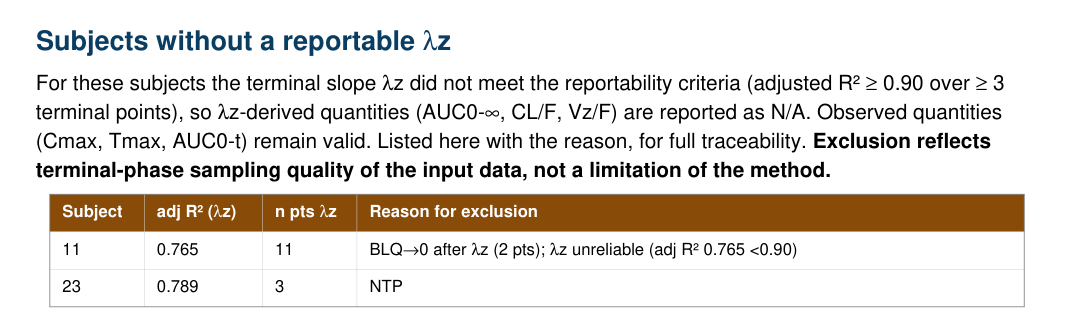
This is what Phoenix does not do out of the box: when the terminal slope fails the reportability criteria (adjusted R² ≥ 0.90 over ≥ 3 points), the λz-derived parameters come back N/A with a named reason — not a confident-looking number the data don't support.
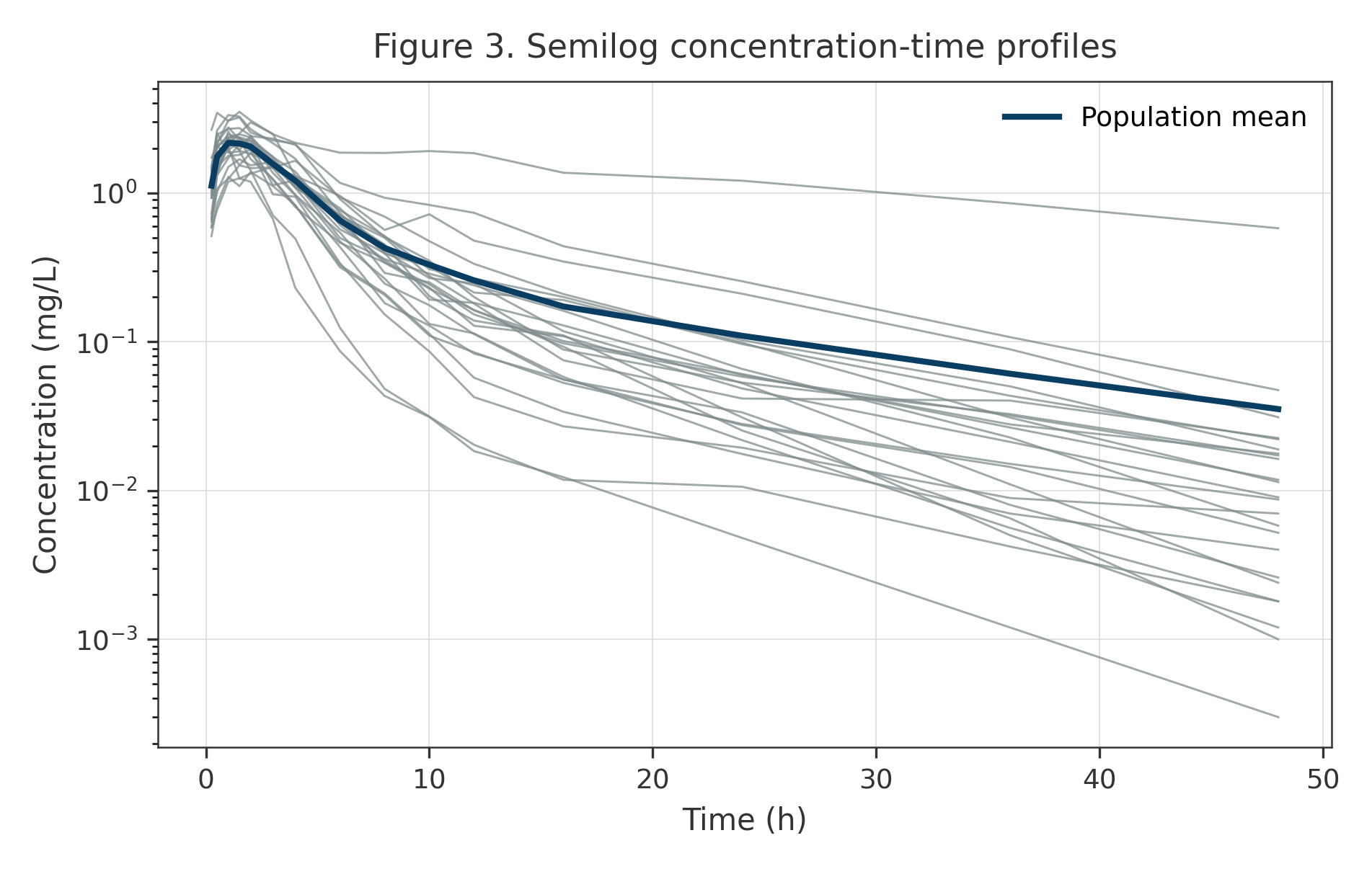
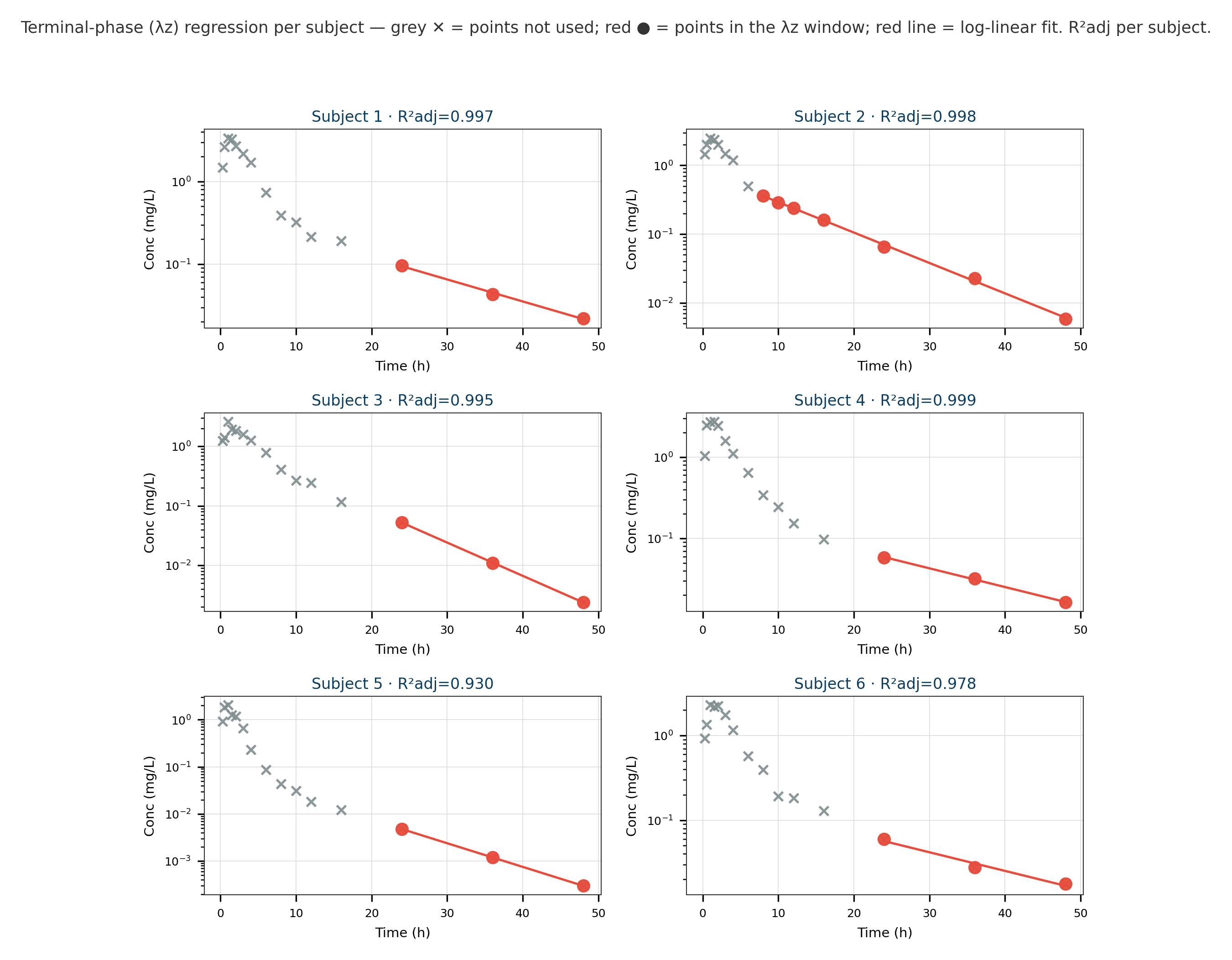
Two engines, two synthetic demonstration datasets (labelled as such in every PDF). Open each one to see the verdict, models compared and diagnostic plots — exactly the report a paying client receives.
Upload your CSV, get a magic-link to the PDF when the fit completes (typically 5–10 minutes), and a copy in your inbox. No subscription, no commitment.
When a subject's terminal slope fails the reportability criteria, its λz-derived parameters come back N/A — listed by name, with the reason, in a "Subjects without a reportable λz" section. bbr / pmtables give you tables; they don't decide what should not be reported.
No CL/F when you haven't declared the dose units. No [P5, P95] at n < 5. No CTD node it cannot assign. Numbers appear at the precision the data support, and not otherwise — epistemic honesty is the point, not a footnote.
Upload a CSV, receive a PDF report + an editable Word draft (a starting template for internal review). The R stack assumes you already have a run and know how to write Quarto templates, pmtables headers and Xpose plotting code.
CSV upload to PDF in your inbox: 5–10 min. Standing up an R / Quarto / PsN pipeline that produces the same self-documenting artefact takes a senior pharmacometrician days to weeks.
When FractaLPK is NOT for you: if you have an in-house pharmacometrics team already running PsN / bbr / pmtables, FractaLPK does not replace that workflow — your team's R pipeline is the right tool. FractaLPK is built for biotechs, CROs and academic groups that need a fast PK answer before opening a full regulatory analysis.