Pre-screening PK reports
for biotech & CROs.
NCA, Bioequivalence, Food-Effect and Dose-Proportionality reports — the standard regulatory PK analyses, generated automatically from a CSV. Plus three advanced engines (Population PK, Tumor Growth, Drug Release) for cases where classical exponential models miss the picture. Non-regulated reports, automatic verdict, PDF in your inbox.
Free trial run. NCA, Tumor Growth and Drug Release are open now: upload your CSV directly, no signup — see pricing for the full Pre-PopPK go/no-go report. Reports are indicative (not for regulatory submission) and your uploaded data and report are deleted within 1 hour. Population PK is available on request. The NCA engine is validated against PKNCA 0.12.1 on the public reference theophylline dataset — see Algorithm Validation. The seven sample reports below use synthetic demonstration datasets, labelled as such in every PDF.
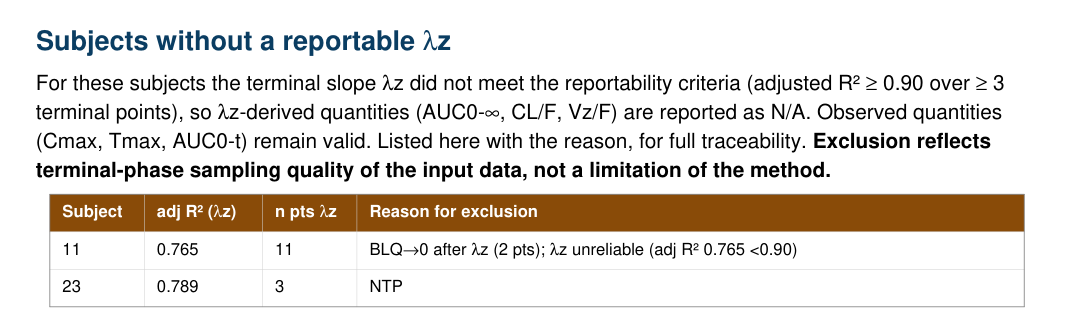
This is what Phoenix does not do out of the box: when the terminal slope fails the reportability criteria (adjusted R² ≥ 0.90 over ≥ 3 points), the λz-derived parameters come back N/A with a named reason — not a confident-looking number the data don't support.
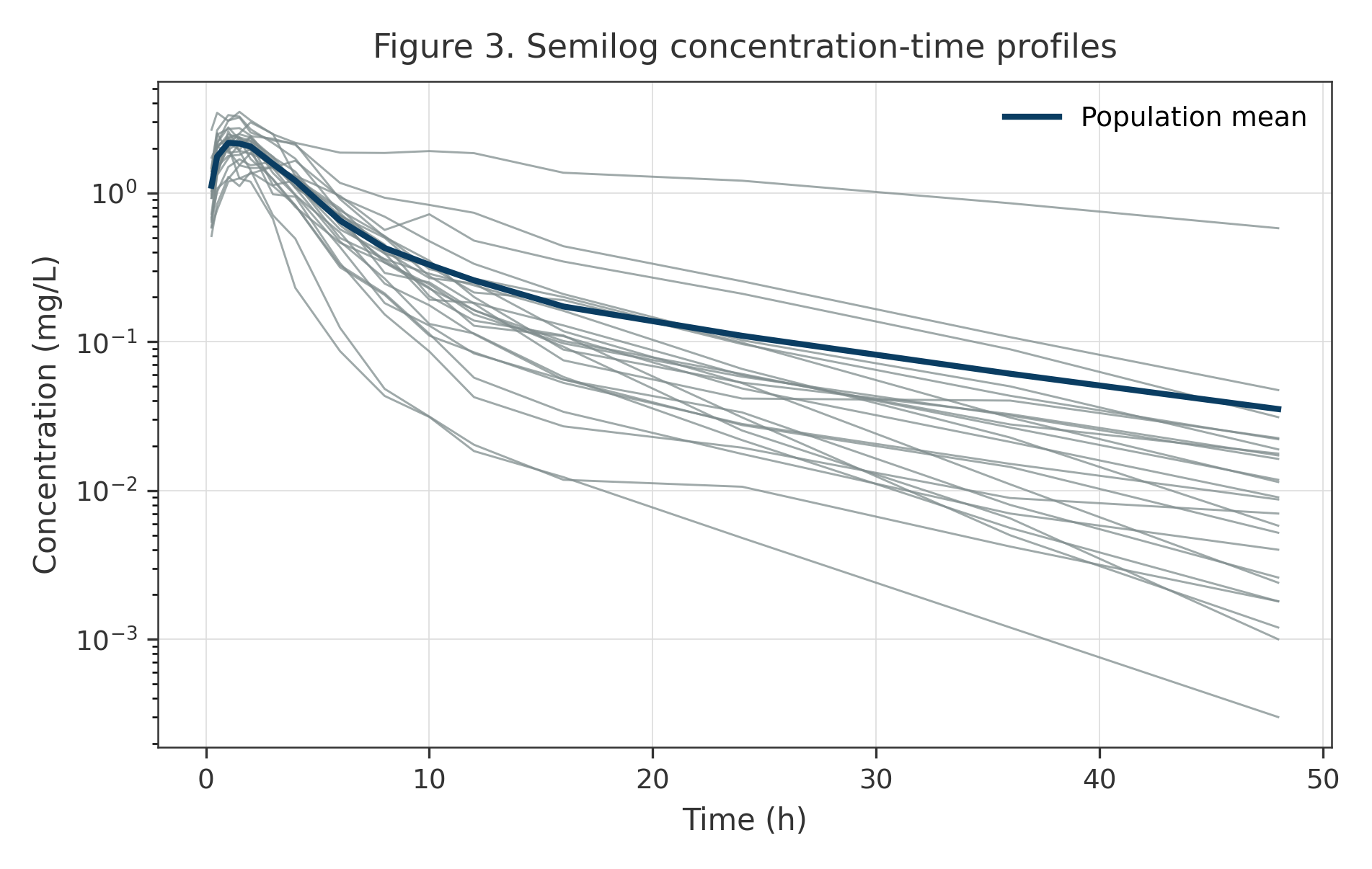
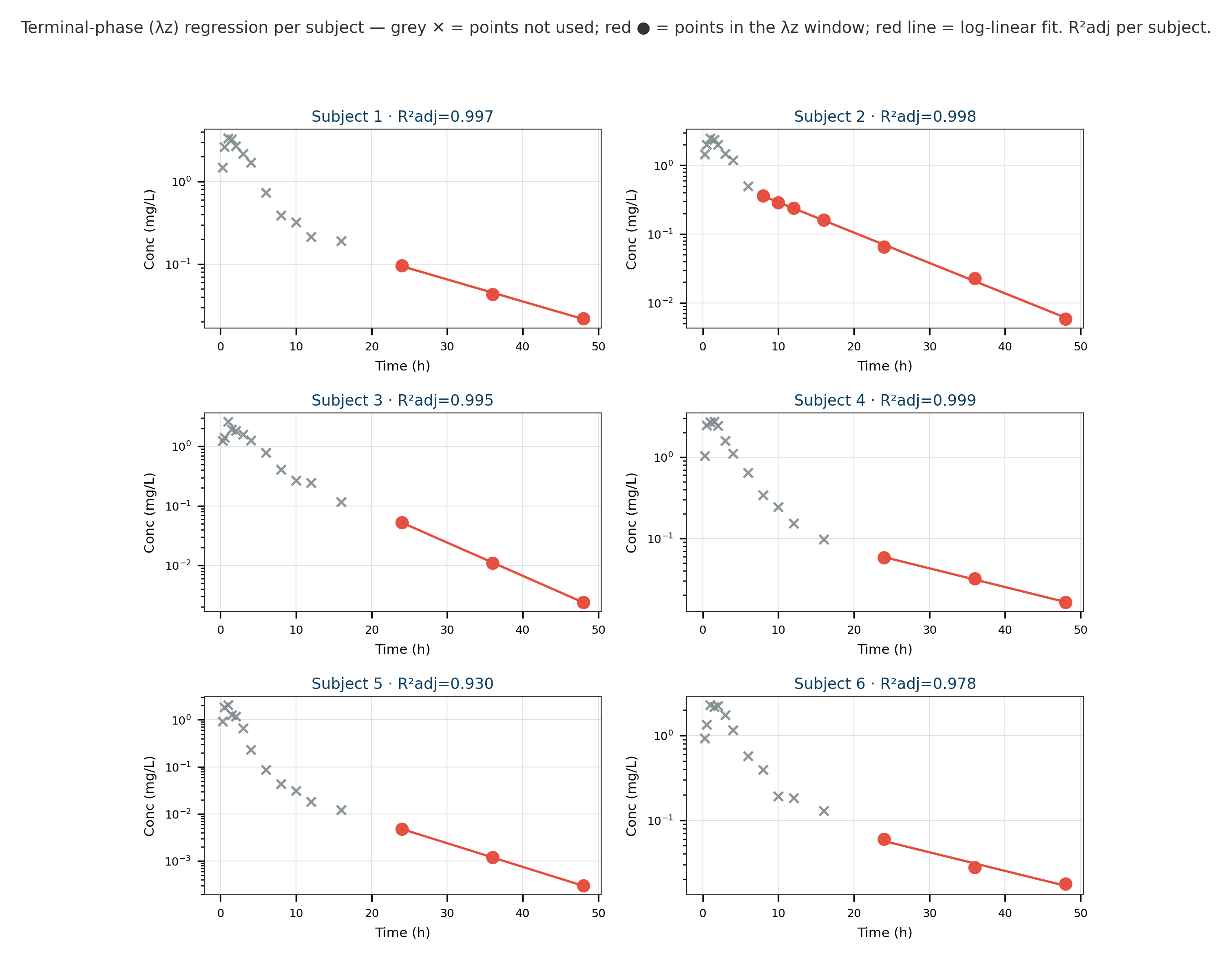
Seven engines, seven synthetic demonstration datasets (labelled as such in every PDF). Open each one to see the verdict, models compared and diagnostic plots — exactly the report a paying client receives.
The open engines (NCA, Tumor, Drug Release) need no request — take a free trial run directly. For Population PK or proprietary-compound work, tell us your name, company and what you're analysing; we reply within one business day with an upload link.
Upload your CSV, get a magic-link to the PDF when the fit completes (typically 5–10 minutes), and a copy in your inbox. No subscription, no commitment.
Screen for memory effects / long tails against classical models. Validated behaviour (rich sampling ~14 points, ≤15% noise): the engine reliably recovers 1-compartment (classical/fractional) and 2-compartment classical structures, and reports statistical indistinguishability rather than crowning a fractional order when the data do not separate them — the common case. A screen, not a fractional-kinetics detector.
Up to 8 candidate models fitted in parallel. The engine ranks them and applies an explicit decision rule — no manual model-selection bias.
Stability check, residuals and "Best fit" badge in every report. If no model wins clearly, the PDF says so — no false-positive verdicts.
Non-regulated, designed to sit before NONMEM / Monolix / PKanalix. Good for biotech early-stage, CROs running internal triage, and academic exploration.
When a subject's terminal slope fails the reportability criteria, its λz-derived parameters come back N/A — listed by name, with the reason, in a "Subjects without a reportable λz" section. bbr / pmtables give you tables; they don't decide what should not be reported.
No CL/F when you haven't declared the dose units. No [P5, P95] at n < 5. No CTD node it cannot assign. Numbers appear at the precision the data support, and not otherwise — epistemic honesty is the point, not a footnote.
Upload a CSV, receive a regulatory-format PDF + editable Word skeleton. The R stack assumes you already have a run and know how to write Quarto templates, pmtables headers and Xpose plotting code.
CSV upload to PDF in your inbox: 5–10 min. Standing up an R / Quarto / PsN pipeline that produces the same self-documenting artefact takes a senior pharmacometrician days to weeks.
Multi-compartment + fractional / Mittag-Leffler PK fits with explicit model-selection rule. For profiles where the terminal phase is heavier than a sum of exponentials predicts.
Higuchi / Korsmeyer-Peppas / Weibull / Mittag-Leffler stretched dissolution fits. Detects long-tail release driven by fractional memory that classical first-order under-models.
Per-animal NLME (nlmixr2 FOCEI) over 6 classical structural models (Exponential / Logistic / Gompertz / Hahnfeldt classical / power-law / exponential-linear); fractional model not reported, selection criterion under review. Real %RSE, OMEGA matrix, η-shrinkage and CWRES — not naive pooled.
Model-risk report aligned with the vocabulary of ICH M15, with identifiability and sampling adequacy measured in pre-registered studies.
Of the 11 structure pairs we tested, 3 can be answered from a single concentration profile and 3 cannot be answered even with 50 subjects. For the remaining 5 we say exactly what is missing rather than give a number. The full table, with every figure traceable, is on the methodology page. Sampling needed before any fractional claim. A pre-registered study (3 360 simulated profiles, Sep 2026) measured what a design must have for each question: one disposition phase or two — 8 sampling points with the last one at 24 h; classical or fractional in a single phase — 8 points with the last one at 48 h, or 12 points to 24 h; classical or fractional in two phases — 24 points with the last one at 168 h, that is seven days. 8 of the 11 structure pairs did not separate under any design tested, up to 32 points and a 168 h window. The report states which of these your profile meets before it fits anything.499 € per analysis · 299 € per month.
Billing is not live yet: trial runs on the open engines are free while we set it up.
- Modules 1-5: data quality, defensible NCA, model screening, identifiability and design, ICH M15 evidence report
- PDF + DOCX + Excel
- PP-SDTM when it ships
- 10 analyses a month, with history
- Everything in the per-analysis plan